Rising damp is groundwater climbing a wall. Everything else — the salt, the lifting paint, the smell — follows from that one fact.
Talk it throughRising Damp Newcastle arranges damp assessments across Newcastle and the Hunter.
Any house can get it. What changes is why.
Older houses often have no working damp course. Newcastle's inner suburbs are full of Victorian and Federation brick — terraces through Cooks Hill and the city, workers' cottages across Wickham, Islington and Tighes Hill. Much of that pre-war brick either never had a damp course, or has one that failed a long time ago.
Newer houses almost always have one, and still get rising damp. The usual cause is that the ground outside has ended up higher than the damp course. A concrete path, a raised garden bed, a slab poured against the wall, a re-levelled yard. Any of those lets water walk straight around the barrier. That happens on a 1990s brick veneer as easily as on a 1900s cottage, and it is usually cheaper to fix.
A shared wall adds a complication either way. If you are in a terrace or a semi, the damp does not stop at the boundary. The wall dries from one face instead of two. And the fix is a conversation with a neighbour before it is a quote.
Salt does the damage. Groundwater carries dissolved salt up into the wall. As the water evaporates the salt stays behind. Near the coast, from Merewether round to Stockton, more salt arrives on the wind. Those crystals grow and push. That is what crumbles mortar and takes the face off a brick. The water moves the salt; the salt breaks the wall.
Newcastle gets a little over 1,100mm of rain a year. Much of it falls in short heavy bursts. East coast lows and summer storms drop more in a few hours than the drains were built to carry. Water arriving that fast does not soak in evenly. It runs off, and it ponds against whatever is in its way. It then sits in the soil around and under the footings for weeks, long after the street looks dry.
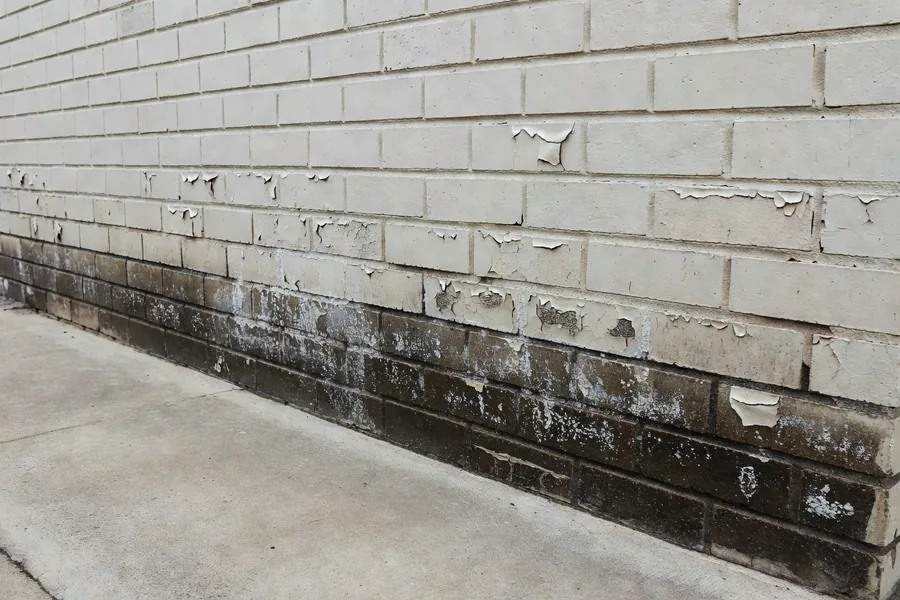
An even horizontal line, roughly 600mm to 1.2m above the floor, on a ground-floor wall. It marks where the water stops climbing and starts evaporating. Condensation does not produce a level line like this.
Salts left behind as the water evaporates. Brushing it off works until the next wet spell.
Almost always a non-breathable coating over a wall that needs to dry outward. The coating is not failing — it is working, in the wrong place.
Salt crystallisation forcing the surface apart. Worst on the coastal strip and usually well advanced before anyone calls it damp.
Not damp. That pattern points at ground movement. Across much of Newcastle that means mine subsidence. That may be compensable, and it needs a different call entirely.
Flash flooding out of the creek catchments charges the ground for weeks. Flood-legacy damp is saltier and more destructive than the everyday kind, and it surfaces months later.
The order matters. Say the real problem is a cracked footing. Injecting a damp course into that wall is money spent on the wrong thing. That is why the assessment comes first and the quote comes after.
Readings up the wall, then outside: levels, the rear lane, paving, downpipes, and whatever render or paint is already stopping the wall breathing.
Stepped cracking points at ground movement, not moisture. In a Mine Subsidence District that is a different call and possibly a compensable one.
Rising damp, lateral damp through a cut-in wall, a leak, condensation, or what a creek flood left behind. On a Newcastle wall all five leave a mark near the floor and only one needs a damp course.
Ground above the damp course is the fix, not a second damp course below it. Injecting under a bridge changes nothing and you will have paid for it.
Injected into one mortar course, sized to the wall thickness. A shared wall is drilled from one side only, so the spacing tightens and the day gets longer.
Salt left in the render pulls moisture out of the air on its own. A wall with a perfect new course and its old plaster still reads damp, and the owner assumes the course failed.
Roughly a month per ten millimetres of wall thickness. Double brick means most of a year before it is ready to paint, and painting early undoes the work.
We arrange assessments across Newcastle and the lower Hunter, including:
 Rising Damp Newcastle